

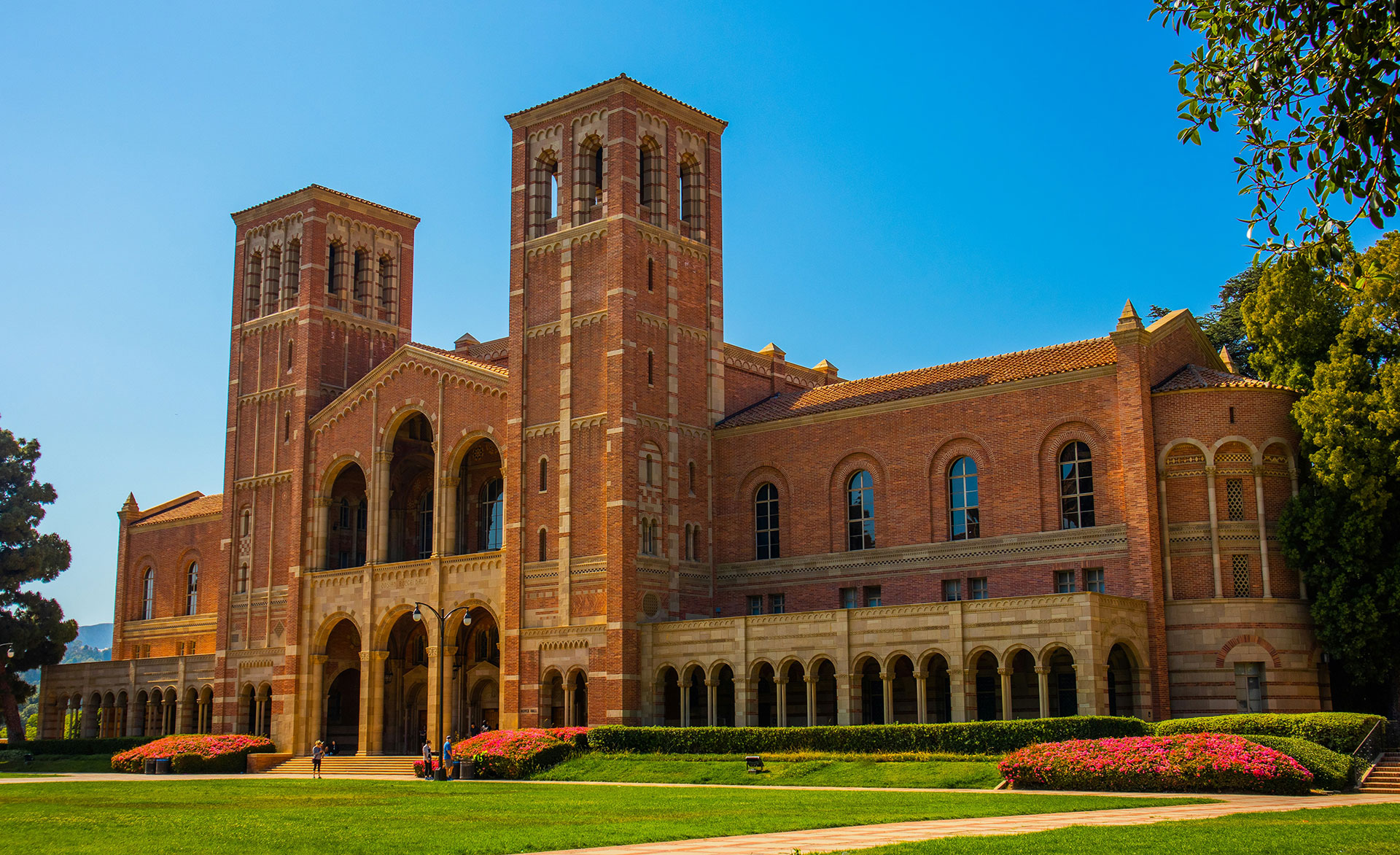
University of California, Los Angeles
Admission Rate:
9%
Undergrad Enrollment:
33,475
Jewish Enrollment:
2,500 (7%)
Tuition:
in-state $36,297; out-of-state $75,567
Test Scores:
UCLA does not require nor recommend students provide scores
Overview
1
Western Civilization & American Civics

2
Jewish & Israel Studies

3
Outstanding Faculty

4
Jewish Life & Israel Engagement

5
Campus Clubs & Intellectual Culture

6
Antisemitism & Anti-Zionism

7
National Rankings


The JNS Campus Report: Our Methodology

This profile is part of the JNS Campus Report, an effort to evaluate American universities according to criteria that truly matter. We assess institutions across seven distinct fields: (1) the depth of their commitment to Western Civilization, American civics, and great books education; (2) the excellence of their teaching in Jewish and Israel Studies; (3) the presence of world-class faculty in the humanities and social sciences; (4) the quality of Jewish life and Israel engagement on campus; (5) conservative and independent intellectual life outside the classroom; (6) the presence and depth of antisemitism and anti-Zionism on campus; and (7) their standing in the national rankings ecosystem.
UCLA has one of the largest Jewish student populations in the country and almost no institutional structure for liberal education. There is no degree program or dedicated faculty in Western civilization or American civics. The Center for Liberal Arts and Free Institutions holds an ACTA Oasis of Excellence designation and is run by Daniel Lowenstein, a professor with an earnest concern for the liberal arts, but its options are limited.
Jewish and Israel studies run through the Nazarian Center for Israel Studies, which supports an Israel Studies minor requiring coursework on Zionism and modern Israel. Its greatest strength is that it is not overtly hostile to Israel and Zionism. The broader Jewish studies faculty includes a number of established professors who have been consistent signatories to anti-Zionist statements, and who teach on the modern state of Israel.
Jewish student life is dense and largely self-organized: roughly 4,000 Jewish students, of whom about 200 are observant. Many of them are from Los Angeles’s Persian Jewish community and commute from home. Chabad at UCLA, founded in 1969, was the first Chabad House on a campus. Hillel houses the Orthodox minyanim, which run three times daily, as well as the campus’s principal kosher dining. Rabbi Aryeh and Sharona Kaplan have directed OU-JLIC there since 2004, longer than any couple in the program nationally. The campus sits inside the Westwood eruv, but the university provides no Shabbat keys.
The post-Oct. 7 record is the more consequential part of the picture. The April 2024 encampment on Royce Quad established exclusion zones controlling access to Powell Library and the surrounding walkways, effectively blocking many Jewish students from access to their own library and parts of campus. The administration did not act for more than a week, until a night attack by outside counterdemonstrators produced numerous hospitalizations, and the clearing the following afternoon ended in 200 arrests.
UCLA’s own task force found that not one student reported satisfaction with how the university handled their complaint. The university paid $6.13 million to settle a lawsuit in July 2025 and now faces two Department of Justice suits.
Western Civilization & American Civics
Does UCLA have BA programs, honors programs, or a unique school focused on the study of Western Civilization and American civic leadership? Are there exceptional programs or departments in the humanities and social sciences?
- UCLA does not have a full-scale degree-granting program or dedicated faculty focused on the study of Western Civilization or American civics. It does offer an ACTA “Oasis of Excellence” in the Center for Liberal Arts and Free Institutions (CLAFI), but the program does not appear to be in strong health.
- CLAFI’s stated purpose is to “study the great works and achievements of Western and other civilizations, with particular emphasis on the foundations of free institutions,” through course offerings and public events. Its website lists recent events, and it is run by Daniel Lowenstein, a professor with an earnest concern for the liberal arts, but the majority of its listed faculty steering committee are dead or retired, and its yearly journal doesn’t list any publications since 2024. The program appears to lack deeper institutional support, and depends on the energies and hard work of the faculty who maintain it.
Jewish & Israel Studies
Does UCLA have excellent professors, courses, or programs on Jewish thought and civilization and on Israel and the modern Middle East?
Carol Bakhos
Professor of late antiquity Judaism. She has written on Judaism and Hellenism, the study of Midrash, and the Talmud in Iran, among other topics.
Nazarian Center for Israel Studies is an interdisciplinary center for Israel Studies. It runs some courses on modern Israel as well as lecture events on Israeli politics and affairs. It also operates an Israeli Studies minor.
- The Israel Studies minor requires courses on Zionism and modern Israel, as well as allowing students to choose from among a large set of courses including courses on Jewish antiquity and classical Jewish texts. Students can take either Arabic or Hebrew to make up the language requirement.
Outstanding Faculty
Does UCLA have world-class faculty in the humanities and social sciences?
John Villasenor
A “professor of electrical engineering, law, public policy, and management,” Villasenor is the co-director of UCLA Institute for Technology, Law, and Policy, and has had fellowships at the Hoover and Brookings institutions and is a member of the Council on Foreign Relations. He teaches on political issues surrounding new technologies.
Steve Zipperstein
Steve Zipperstein is the director of the Nazarian Center for Israel Studies, and teaches courses on public policy and the effects of globalization on politics.
Jewish Life & Israel Engagement
How strong is Jewish life on campus — including religious community, rabbinic leadership, kosher infrastructure, and pro-Israel engagement?
Chabad
Founded in 1969, Chabad at UCLA was the first campus Chabad House anywhere.
- Programming: Chabad hosts large and popular Friday night dinners, runs shacharit in the morning, and offers extensive classes and learning opportunities alongside social programming including challah bakes and a kosher cooking club.
- Learning: Sinai Scholars teaches fundamental concepts of Jewish thought and religion and is oriented toward non-Orthodox students.
- Student Leadership: Students take leadership roles through a student board.
UCLA Hillel
Hillel houses the Orthodox minyanim and the OU-JLIC operation, and runs the campus’s principal kosher dining.
- Leadership: Rabbi Toba Schaller is the rabbi at UCLA Hillel, holding rabbinical ordination and an MA in Religious Education from Hebrew Union College.
- Kosher Dining: Hillel operates a meat cafeteria serving lunch Monday through Thursday, accessible by cash or meal swipe, and a fully kosher Coffee Bean and Tea Leaf.
OU-JLIC
Rabbi Aryeh and Sharona Kaplan are the OU-JLIC couple at UCLA and the longest-tenured couple in the program nationally, having started in 2004.
- Background: Rabbi Kaplan studied at Yeshivat Har Etzion and Yeshiva University and also serves as executive director of OU-JLIC West, supervising directors across the western region. Sharona Kaplan holds a Stern College degree and a master’s in social work from Yeshiva University.
- Programming: Rabbi Kaplan leads the Orthodox Shabbat day service and teaches individual and group classes almost daily, including near-daily lunch-and-learns with free lunch. The couple host Shabbat lunch for 30 to 40 students and are well liked by the observant community.
Olami
Rabbi Shmuel and Rachel Benady direct Olami at UCLA. They maintain a house with two apartments where about ten male students live, and host small Shabbat lunches weekly.
Religious Infrastructure
UCLA has approximately 4,000 Jewish students, among the largest Jewish undergraduate populations in the country, of whom roughly 200 are observant. The observant community has a distinctive composition: many, perhaps most, are part of Los Angeles’s Persian Jewish community and live at home, commuting to campus.
- Kosher Dining: Available through the Hillel cafeteria, the kosher Coffee Bean and Tea Leaf, and a limited pre-packaged microwavable menu at DeNeve Dining Hall.
- Daily Minyanim: Orthodox minyanim run three times daily at Hillel.
- Eruv: UCLA sits within the Westwood eruv.
- Shabbat Keys: UCLA does not provide Shabbat keys. For a campus with roughly 200 observant students, this is a concrete gap.
- Housing: Most observant students live either at home or at The Bayit, a Jewish housing co-op founded in 1974 located off campus among the fraternity houses. Some live at the Olami house, which accommodates male students only.
Pro-Israel Engagement
Bruins for Israel is Hillel’s pro-Israel group. Students Supporting Israel operates independently, and BIPAC, the Bruins Israel Public Affairs Commission, is the campus lobbying group. TAMID connects students to Israeli business and industry.
- Broader Jewish Organizations: The Jewish organizational landscape is unusually dense. Ha’am is the Jewish student newspaper, AEPi the Jewish fraternity, and PCH the Persian Jewish affinity group at Hillel. Jewish Law Students and the Jewish Med Students Group serve the professional schools. Chai on Life organizes a quarterly Shabbat nature retreat, and Tikun Olam Makers is a Jewish 3D-printing club.
- Campus Environment: After October 7 the campus was, and remains, hostile to Israel and Zionism. Students report discomfort being outwardly pro-Israel in the classroom or among non-Jewish peers.
Campus Clubs & Intellectual Culture
What intellectually serious clubs, publications, and organizations exist outside of the formal curriculum?
Tikvah Campus Chapter — Tikvah students maintain a chapter for the discussion of the great Jewish and Western ideas.
Antisemitism & Anti-Zionism
How strong are anti-Semitic and anti-Zionist groups and activities on campus? Are there prominent faculty that advance ideas that are actively hostile to Israel and the Jewish people?
UCLA was among the most violent and legally consequential campuses in the country after October 7. The events of spring 2024 produced physical injury, dual civil rights lawsuits from opposing sides, a $6.13 million settlement paid to Jewish plaintiffs, an ongoing Department of Justice suit, and the resignation of a chancellor. The institutional failure at issue is not that the university took a side. It is that for over a week it did not act at all.
The Palestine Solidarity Encampment was established on Royce Quad on April 25, 2024, organized by Students for Justice in Palestine with Faculty for Justice in Palestine, the UC Divest Coalition, and Jewish Voice for Peace, alongside IfNotNow and the Harriet Tubman Center for Social Justice. It grew to roughly thirty tents and several hundred demonstrators and established a physical perimeter of plywood and commandeered university bike racks, blocking access to Royce Hall and Powell Library, the largest undergraduate library. The administration’s statement the following day affirmed the need to support both safety and free expression and noted that UC policy barred calling in law enforcement preemptively. UCLA dispatched security, which erected further metal barriers around the encampment rather than removing it.
Encampment personnel then began managing pedestrian movement through the central public space they occupied, preventing people they deemed unwelcome from reaching Powell Library and the surrounding walkways. These became widely known as exclusion zones, and they are the factual center of the litigation that followed.
Clashes between encampment affiliates and counterdemonstrators began on April 28 when the separating barricades were overrun. Escalation continued through April 29 and 30, including a pro-Palestine faculty walkout and footage of an injured Jewish counterdemonstrator who said she was dragged by her hair and sustained a concussion. On April 30 the administration called for the encampment to disband as unlawful, and Royce Hall and Powell Library were closed for the week.
Late that night, a large group of counterdemonstrators, reportedly non-student in origin, attacked the encampment. They were armed with sticks, mace, and fireworks, and fought for hours with those inside as they attempted to breach the barricades. The night resulted in numerous hospitalizations. According to eyewitnesses within the encampment, campus security looked on and did not intervene for several hours. Police ordered the encampment to dissolve the following afternoon and encountered significant resistance, using pepper spray and batons and allegedly firing rubber bullets; 200 remaining demonstrators were arrested. A second, smaller encampment on Dickson Plaza and an attempted building occupation followed in May, neither of which held.
UCLA’s own Task Force to Combat Antisemitism and Anti-Israel Bias reported in October 2024 after sampling more than 400 Jewish and Israeli members of the university community. Sixty-seven percent rated antisemitism a problem or serious problem and seventy-five percent said the same of anti-Israel bias; eighty-five percent said both had worsened since October 7, and roughly two-thirds identified the encampment as a source. Nearly two-thirds had witnessed discrimination and nearly half had witnessed assault or physical harassment. Over eighty-one percent of faculty and staff respondents reported that antisemitism was taken less seriously than other forms of bigotry. On complaint handling the finding was categorical: not one student reported satisfaction with how the university handled their complaint.
Chancellor Gene Block’s administration was criticized from every direction. Jewish and pro-Israel students saw the surrounding police presence as effectively guarding the encampment; those inside it objected to the same presence. In May the Academic Senate rejected a no-confidence vote in Block, 50 percent against to 43 percent in favor. Block resigned in summer 2024, not as a direct response to the encampment. The UCLA police chief was reassigned and a new Office of Campus Safety was created under Rick Braziel.
The litigation has been consequential. Frankel v. Regents of the University of California, filed in June 2024 by three Jewish students and a faculty member, alleged that the encampment created a de facto exclusion zone barring Zionists—a category applied at the protesters’ discretion and extending to most Jewish students—and that UCLA’s refusal to intervene for over a week made it a tacit participant. UCLA contested the case for over a year and, on July 29, 2025, agreed to pay $6.13 million to settle. Blair v. Regents, filed in October 2024 by demonstrators alleging excessive force, remains in litigation; a judge ruled in November 2025 that it may proceed.
As of February 2026, the Department of Justice is suing UCLA over what it claims was a "hostile work environment" created by the university amidst the Spring 2024 protests. As of August 2026, the court case has progressed, representing the most tangible aftershock of the protest season. Numerous parties from both pro-Israel and pro-Palestine-affiliated entities have filed motions or otherwise become involved in legal proceedings related to the case. In April 2026, a handful of Jewish faculty joined on to become parties in the suit, alleging that UC had created a hostile work environment.
On May 26, the DOJ followed with a second suit against UCLA, this time alleging that UC had created or abetted a hostile and discriminatory environment for its students, as opposed to the first suit, which had centered on faculty. The new lawsuit was likewise filed under Title VI, rather than VII. UCLA and UC pushed back strongly. Chancellor Julio Frenk emphasized UCLA’s reorganization of its civil-rights apparatus, appointment of a Title VI officer, new campus-safety leadership, and antisemitism initiative; UC President James Milliken argued that the suit ignored reforms already undertaken.
In May 2025, UCLA’s Initiative to Combat Antisemitism released a report recommending, among other steps, that UCLA adopt the IHRA Working Definition of Antisemitism, prevent faculty and staff from engaging in large-scale civil disobedience with antisemitic undertones, ensure that UCLA is not responsible for funding or distributing antisemitic materials, and shore up anti-discrimination and broader disciplinary policies.
Governance and student climate has seen mixed results. The Undergraduate Student Association Council universally approved a letter condemning an event hosted by multiple Jewish organizations featuring Israeli former hostage Omer Shem Tov on April 14. Nonetheless, the administration supported the event, and it was attended by Chancellor Frenk, whose parents had fled Nazi Germany.
Discipline was handled case by case through student conduct channels. The university neither granted the amnesty sought by activist legal groups nor imposed broad sanctions. In March 2025 the Office of Student Conduct recommended indefinite censure of undergraduate SJP following a protest outside the home of a UC Regent.
Faculty involvement was organized and participatory rather than merely rhetorical. The campus Faculty for Justice in Palestine chapter issued coordinated statements supporting the encampment, held press conferences, and repeatedly criticized the administration’s enforcement decisions. Faculty joined demonstrations, held their own walkout on April 29, and were present at encampment events; some were arrested alongside students. A number publicly challenged the designation of the encampment as unlawful. The Asian American Studies Department issued a departmental solidarity statement with the demonstrators. Many members of the Jewish Studies department signed solidarity statements downplaying anti-Semitism on campuses or demonizing Israel.
UCLA faculty of concern include, or have recently included:
- David Myers (Distinguished Professor and chair in Jewish History)
- Myers directs the UCLA Initiative to Study Hate, has directed the Luskin Center for history and Policy and the Center for Jewish Studies. On October 8, 2023, he wrote in the LA Times that in the wake of Hamas’s “stunning” attack, Israel must realize “that it cannot batter Palestinians into submission,” and “[b]ringing an end to the stranglehold of the occupation may be the best chance to break the cycle of violence.” In August 2023, he was signatory to a letter accusing Israel of being a Jewish supremacist, apartheid state that was attempting to ethnically cleanse “occupied territories.” In December 2023, he was signatory to a letter that laid the blame for the October 7 attacks at Israel’s feet: “We denounce the October 7 attacks. At the same time, 75 years of displacement, 56 years of occupation, and 16 years of blockade have generated an ever-worsening spiral of violence that can only be stopped with a political solution.”
- Dov Waxman (Chair in Israel Studies)
- Waxman has written extensively on contemporary issues around Israel and teaches on the Israel-Palestine conflict. Though, for some time after October 7, he was publicly engaged in Israel’s rhetorical defense, he was a 2023 signatory to a letter accusing Israel of being a Jewish supremacist, apartheid state that was attempting to ethnically cleanse “occupied territories.” In 2025, he further wrote that “what Israel is doing to Palestinians in Gaza amounts to the crime of genocide.”
- Eric Martin
- According to Poppy Press, a student-run publication at UCLA, Martin was a lecturer with UCLA’s Center for the Study of Religion for six years, and was fired after being arrested at an anti-Israel encampment. While tenured and tenure-track avoided sanctions, as a lecturer, Martin was subject to an HR investigation and was fired after declining to participate in the investigation.
- Michael Rothberg (Professor of English and 1939 Society Chair in Holocaust Studies)
- Rothberg teaches on Holocaust studies and postcolonial studies, among other topics. In August 2023, he was signatory to a letter accusing Israel of being a Jewish supremacist, apartheid state that was attempting to ethnically cleanse “occupied territories.” In December 2023, he was signatory to a letter that laid the blame for the October 7 attacks at Israel’s feet: “We denounce the October 7 attacks. At the same time, 75 years of displacement, 56 years of occupation, and 16 years of blockade have generated an ever-worsening spiral of violence that can only be stopped with a political solution.” He signed onto a statement on October 15, 2023, “sound[ing] the alarm about the possibility of the crime of genocide being perpetrated by Israeli forces against Palestinians in the Gaza Strip.”
- Sarah Abrevaya Stein (Distinguished Professor and Viterbi Family Endowed Chair in Mediterranean Jewish Studies)
- Stein is an eminent scholar in Sephardic studies whose books have won numerous awards. From 2018-2024 she was the director of UCLA’s Leve Center for Jewish Studies. During that tenure, in August 2023, she signed onto a statement accusing Israel of being a Jewish supremacist, apartheid state that was attempting to ethnically cleanse “occupied territories.”
National Rankings
How does UCLA perform in various national rankings?
- Manhattan Institute/City Journal— In Fall 2025, the Manhattan Institute/City Journal produced a new system of college rankings assessing schools on intellectual seriousness, cultural sanity, and overall educational value. The MI/City Journal methodology offers cumulative rankings as well as category-specific rankings.
- UCLA ranks 40th overall.
- It ranks 38th in Educational Experience and 90th in Curricular Rigor, reflecting a lack of strong, required liberal arts or civics coursework.
- UCLA ranks 24th in Heterodox Infrastructure, but 87th in faculty speech climate.
- UCLA ranks 62nd in Leadership Quality, 85th in Commitment to Meritocracy, but 19th in Resistance to Politicization—the low scores overall reflect UCLA’s large DEI bureaucracy and activist institutional commitments.
- UCLA ranks 97th for “Jewish Campus Climate.”
- UCLA ranks 17th in Outcomes, outperforming its overall position. It ranks 10th in “Payback Education Investment” and 10th in “Value added to Education,” but 81st in “Value Added to Career.”
- Wall Street Journal — The WSJ rankings weight outcomes heavily (70%), with salary impact (50%) and graduation rate impact (20%) the dominant factors.
- UCLA is currently 80th in WSJ rankings. It scores somewhat low on salary impact but very high on graduation rate, and is brought further down by a low diversity score and poor survey results.
- ACTA’s “What Will They Learn?” — ACTA grades schools on the strength of their college-wide liberal arts curricula, scoring universities on how many of seven core subjects are required of all undergraduates.
- UCLA earns an F. Of the seven core subject areas, UCLA only requires one: composition.
- ACTA credits the Center for Liberal Arts and Free Institutions as an “Oasis of Excellence.”
- ADL Campus Antisemitism Report Card — In response to the troubled campus environments in the wake of October 7, the ADL has been grading schools on antisemitism from F to A.
- ADL gives UCLA a B (marked as an improvement). UCLA receives the highest possible scores in publicly disclosed administrative actions (above expectations) and in Jewish life on campus (excellent), while receiving the middle score in campus conduct and climate concerns (medium).
- UCLA nearly full marks for administrative actions and Jewish life, with various levels of alarm for anti-Semitic and anti-Zionist activity and incidents.
- U.S. News & World Report — UCLA is 17th in the USNWR national university rankings.
- FIRE — The Foundation for Individual Rights and Expression ranks UCLA 94/261 on free speech, up 95 places from 2025. UCLA receives an overall grade of D, with a “green” spotlight rating, and F grades for political tolerance and administrative support.
- Forbes — UCLA is 15th on the Forbes list, reflecting high median salaries, high graduation rates, and the number of UCLA graduates in prominent positions across various fields.


